the Cogito keyboard
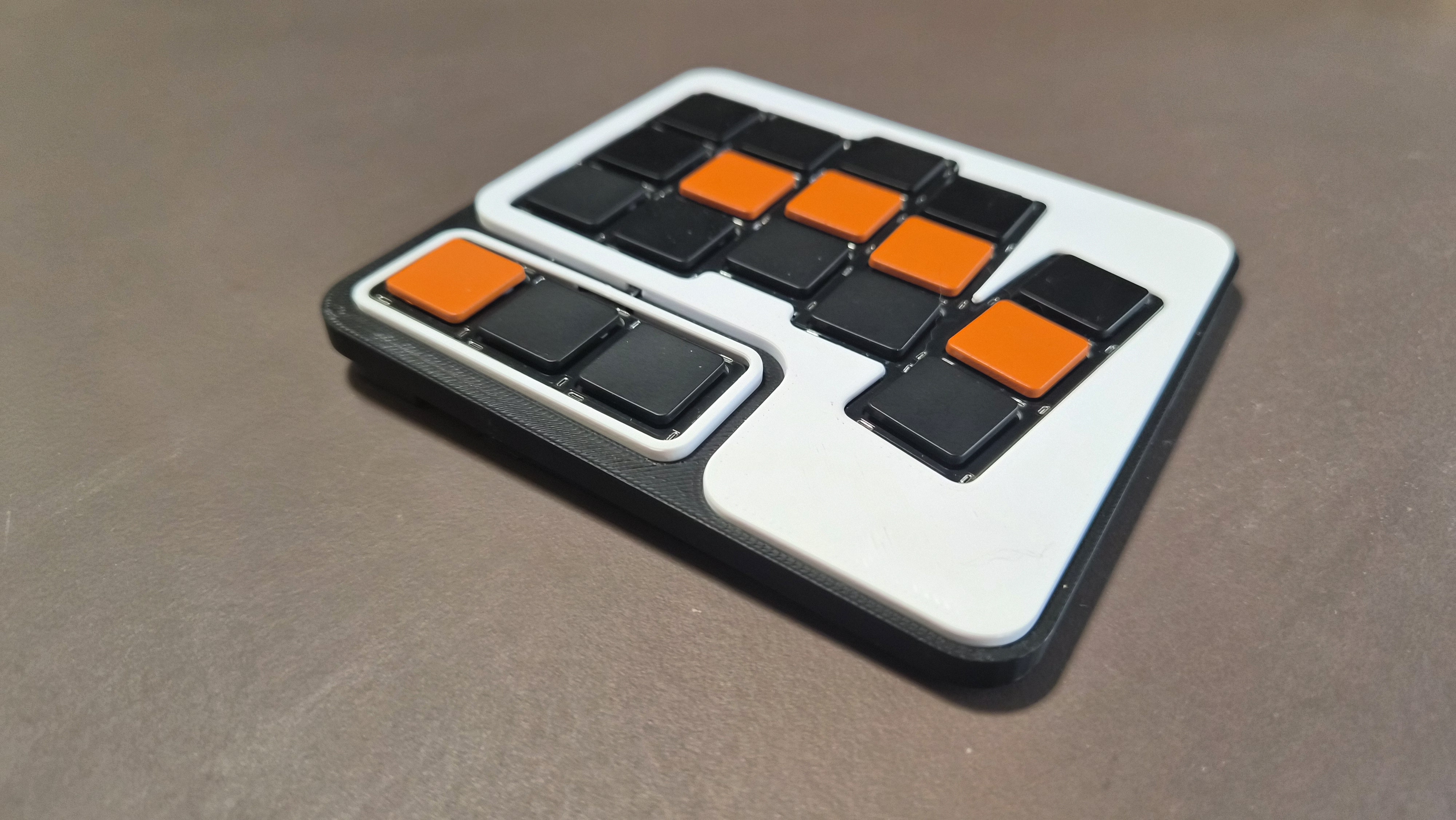
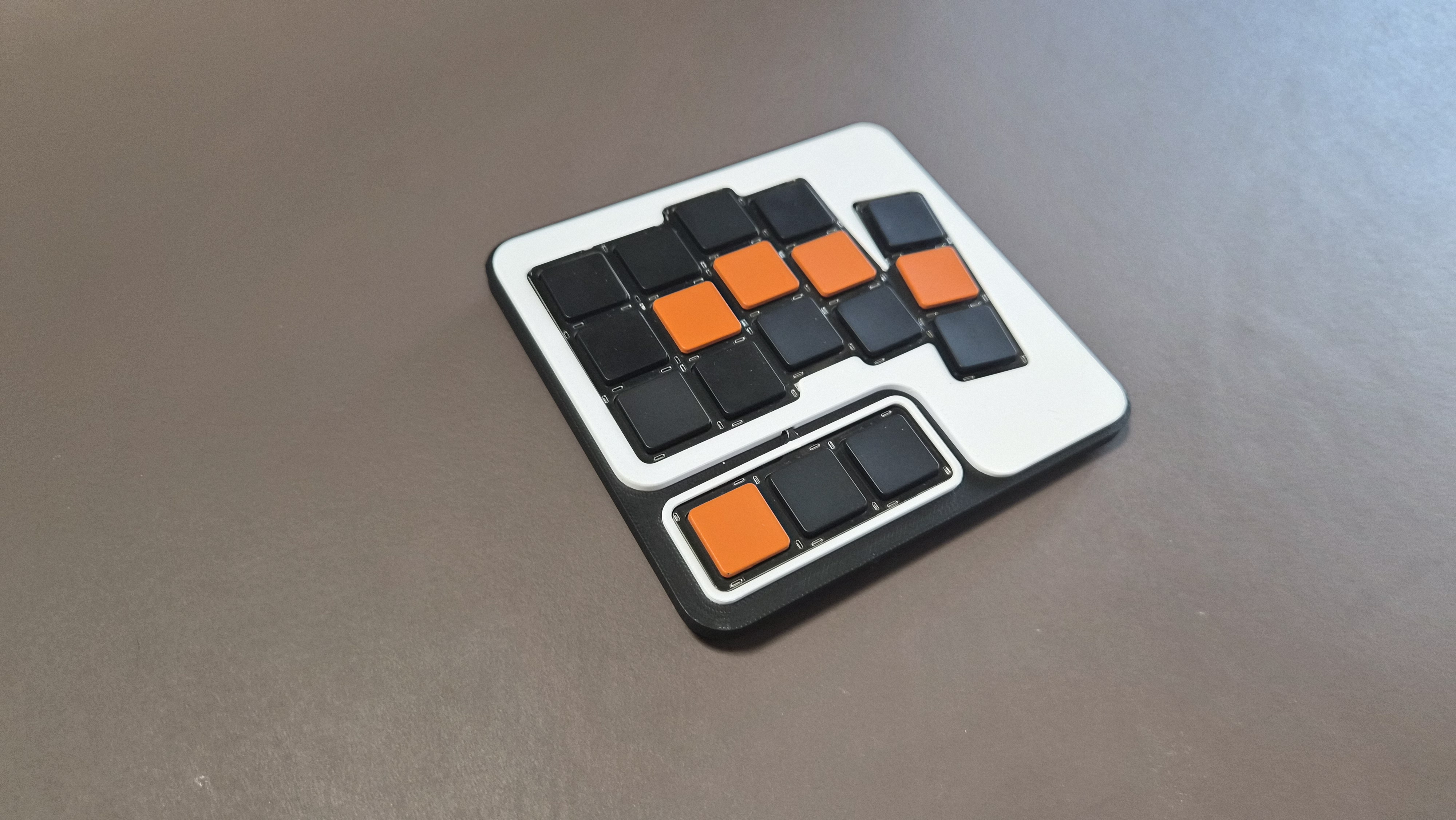
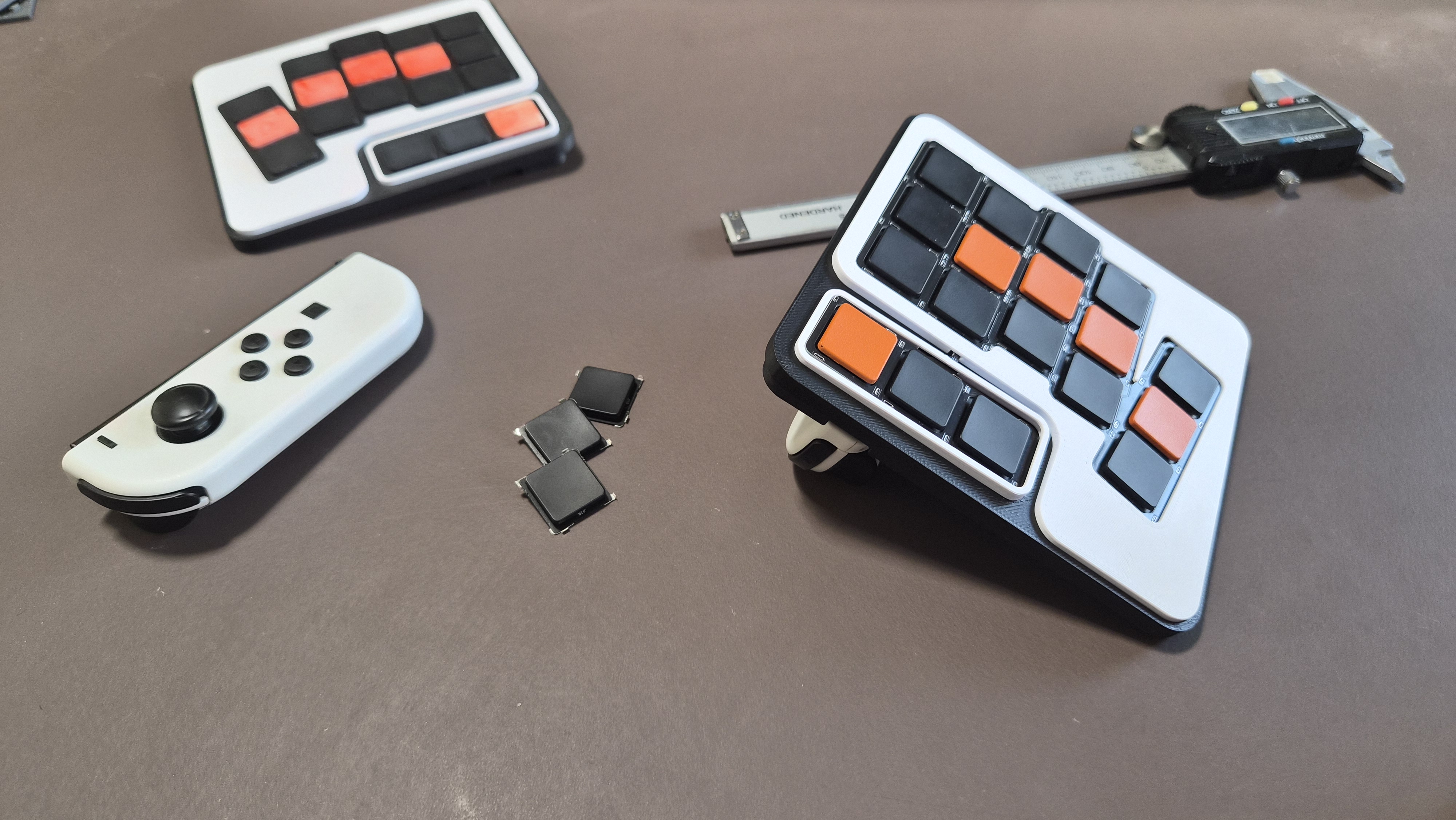
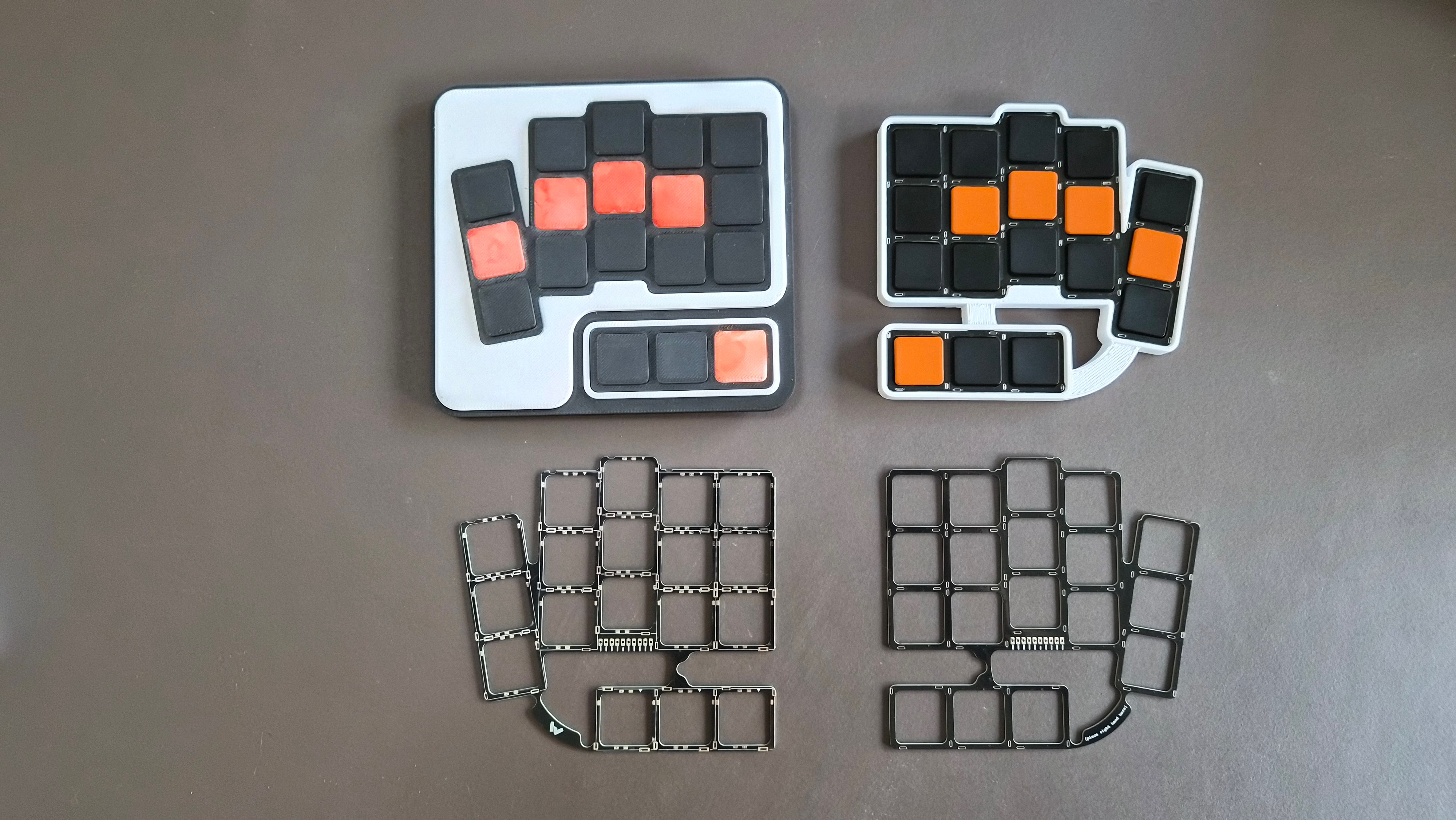
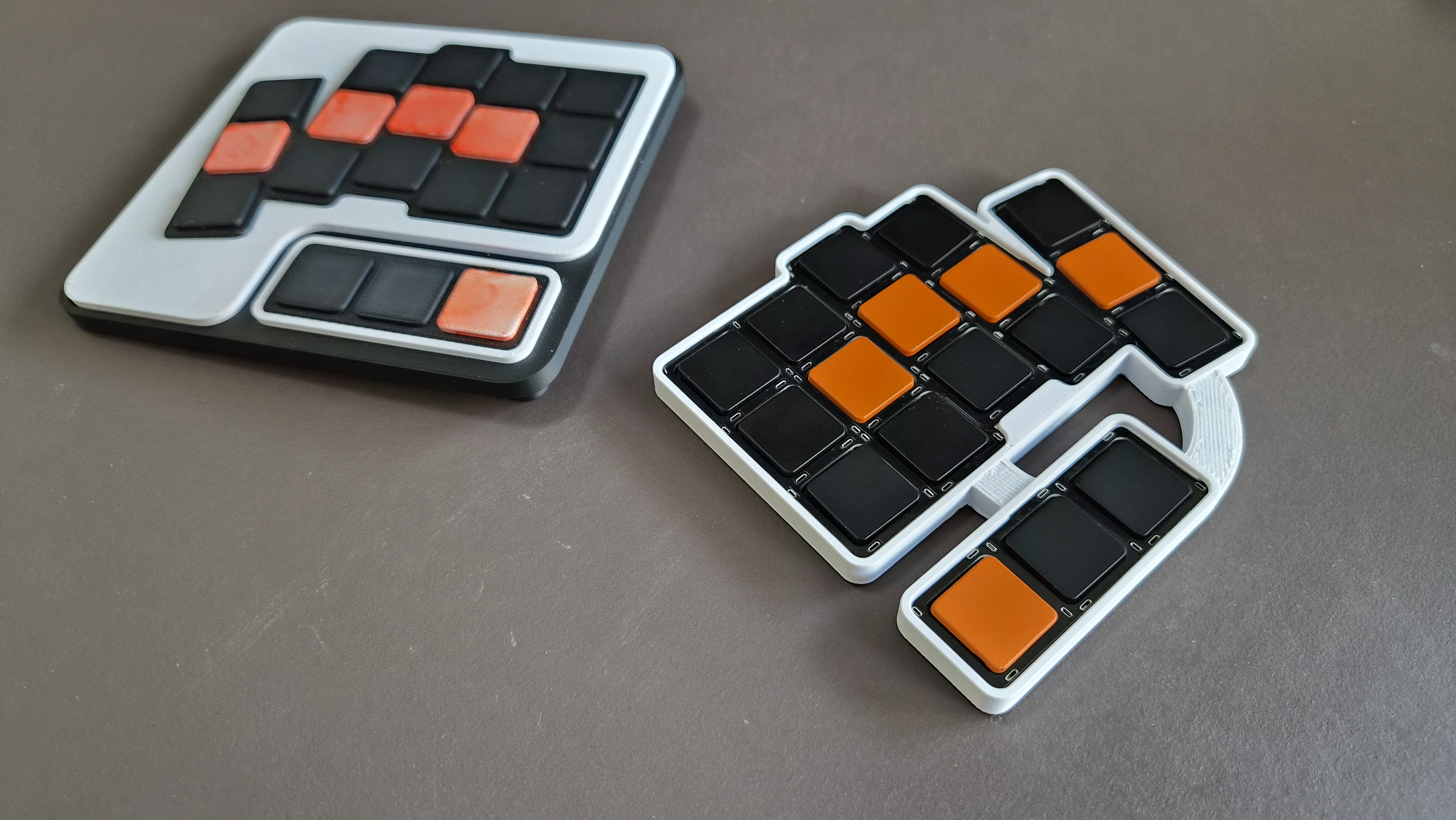
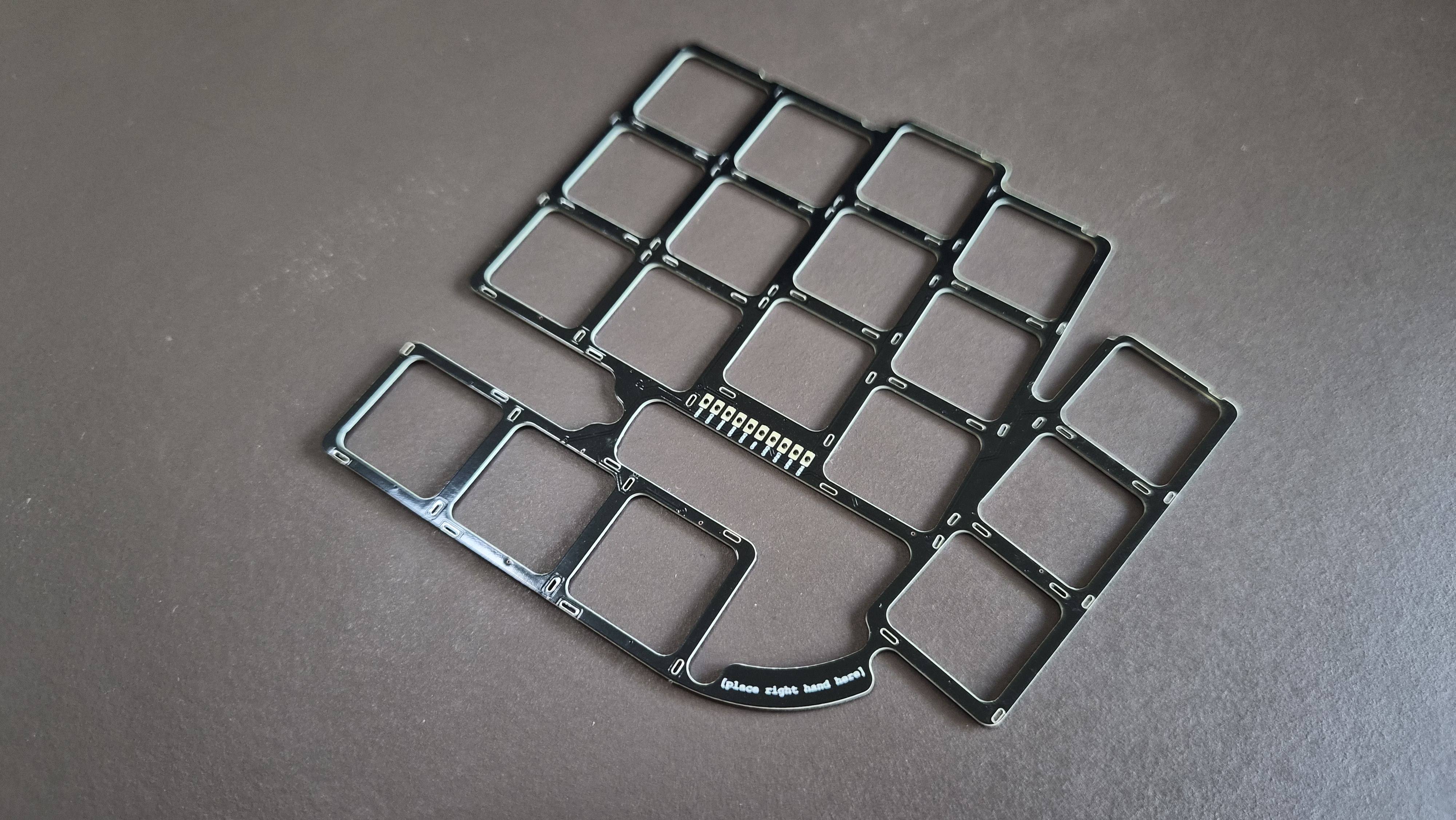
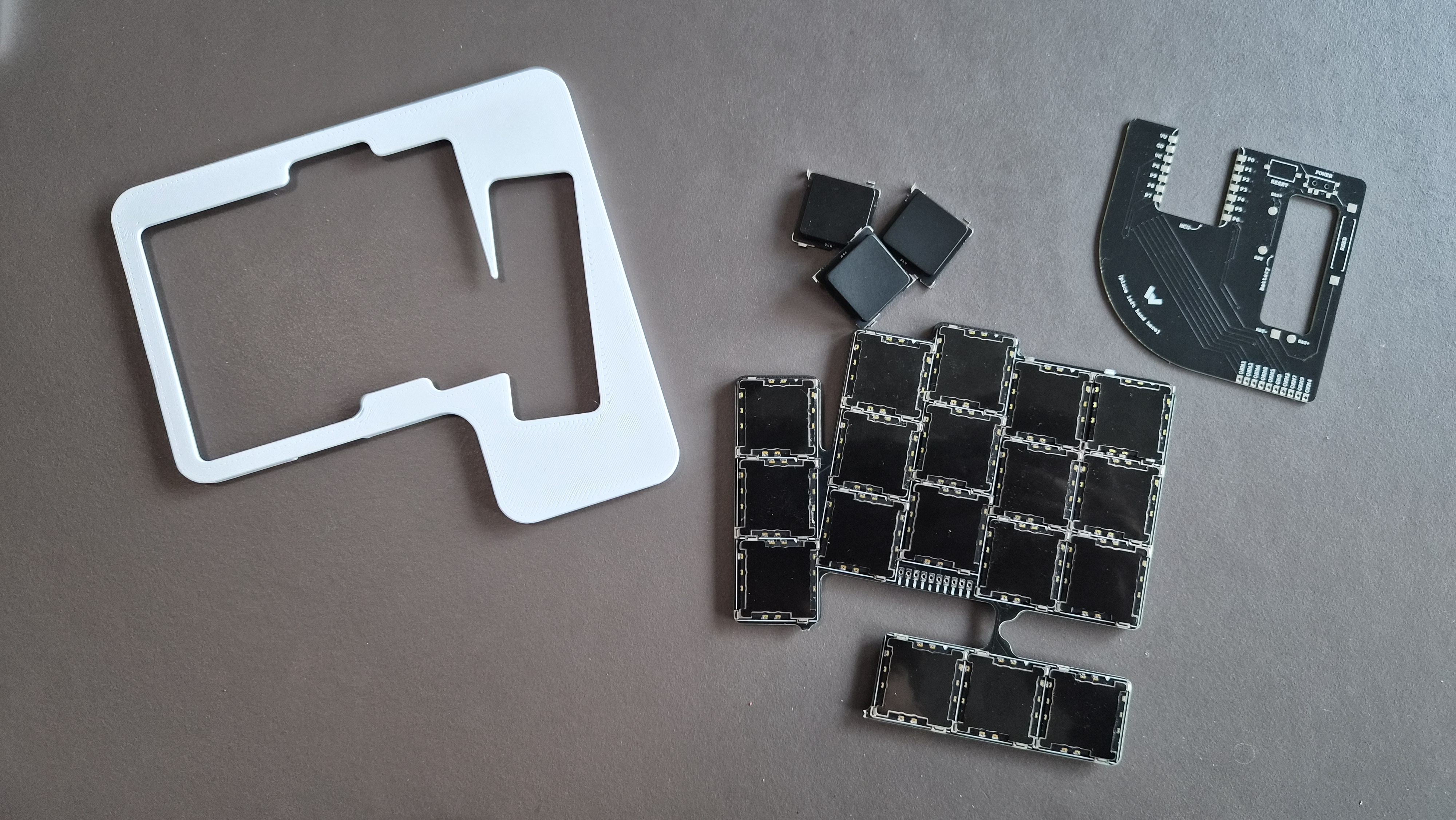
FIG 02. ONE HALF OF THE COGITO ERGO+ AND THE COGITO ERGO // APRIL '26
“
What if the keyboard we use every day was actually tailored to human hands?
”the Vision
The Cogito is an ergonomic split keyboard built not by improving what already exists, but by discarding it entirely. Designed from first principles — and from the actual measurements of a human hand — it is the result of asking the question most keyboard designers have never asked: what would this look like if the typewriter had never existed?
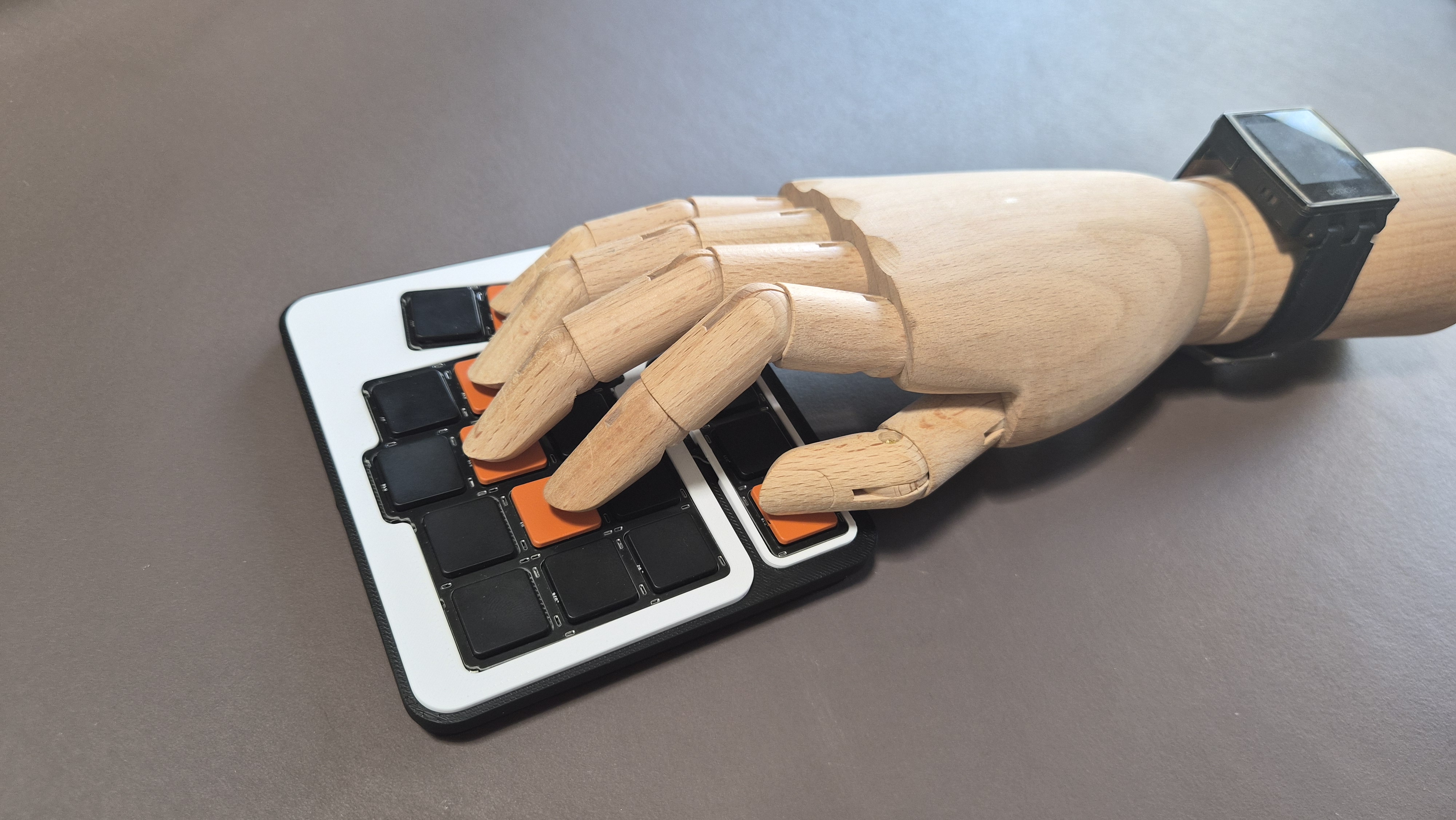
The answer, after more than fifty 3D-printed prototypes, is a keyboard that fits the hand rather than a hand that accommodates the keyboard. Columnar stagger tuned to actual finger lengths. A pinky cluster rotated to match the natural divergence of the fifth finger. A thumb arc designed around the direction the thumb actually moves — inward, not outward. And a layout compact enough that every key is reachable from a resting hand that never needs to move.
the Cogito would have never been possible without the countless hours that other people have put into designing their own 'endgame' keyboard and shared their knowledge (and code) with the world. If you're looking for inspiration I highly recommend checking out the following resources:
the Origin
The Cogito didn't emerge in a vacuum. It sits at the end of a long lineage of inherited compromises — each one unchallenged, passed from one generation of keyboards to the next.
1868
The Typewriter
Christopher Latham Sholes patents the first commercially successful typewriter. The QWERTY layout is designed not for human fingers, but to prevent mechanical typebars from jamming — spacing frequently paired letters apart so the metal arms have room to retract before the next one swings.
1873
The Layout is Fixed
Remington begins mass-producing the Sholes & Glidden typewriter. The QWERTY layout is cast in metal. From this moment, no subsequent generation of engineers will question whether the arrangement of the keys reflects the anatomy of the hand. It doesn't. It never did.
1936
Dvorak Tries
August Dvorak patents an alternative layout optimised for finger travel and hand alternation. It is measurably more efficient. It is adopted by almost no one. The weight of a billion trained typists proves too heavy to lift.
1984
The Keyboard Goes Digital
IBM standardises the 101-key layout for the PC keyboard. The typewriter's mechanical constraints — the stagger, the flat surface, the single spacebar — survive the transition from metal to silicon perfectly intact. The machine changes. The layout does not.
2006 – present
The Ergonomic Attempts
A wave of ergonomic keyboards — split, tented, curved — attempts to address the postural damage caused by the standard layout. Most split the rectangle in half and call it done. Few question the stagger. Almost none redesign the thumb cluster or measure the fingers.
2023
The First Iteration
Work begins on what would later become the Cogito. A very first — and very simple — 3D model is designed and sent out to be printed, since owning a 3D printer is still a prototype away.
Watt IV
2026
The Cogito
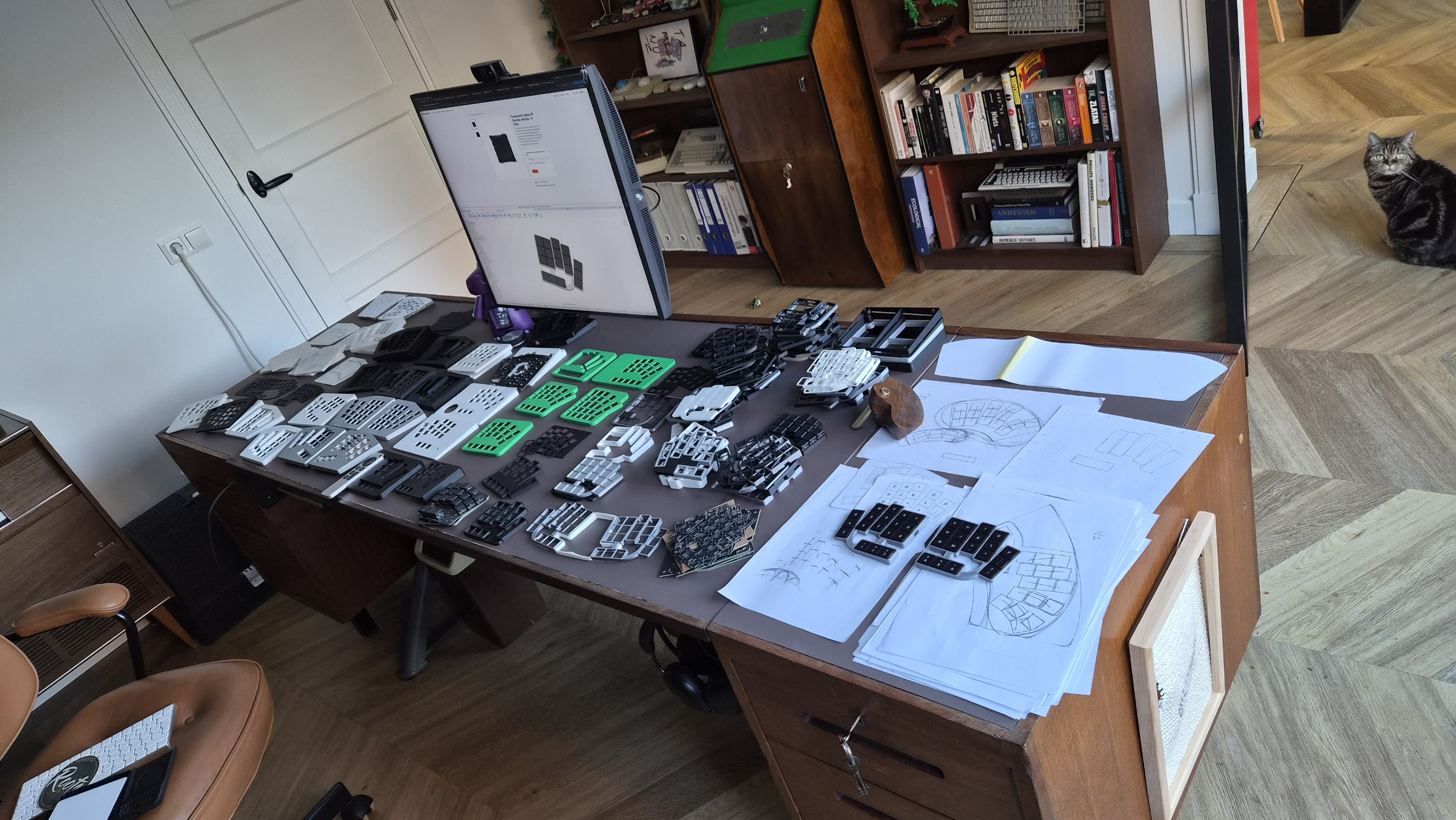
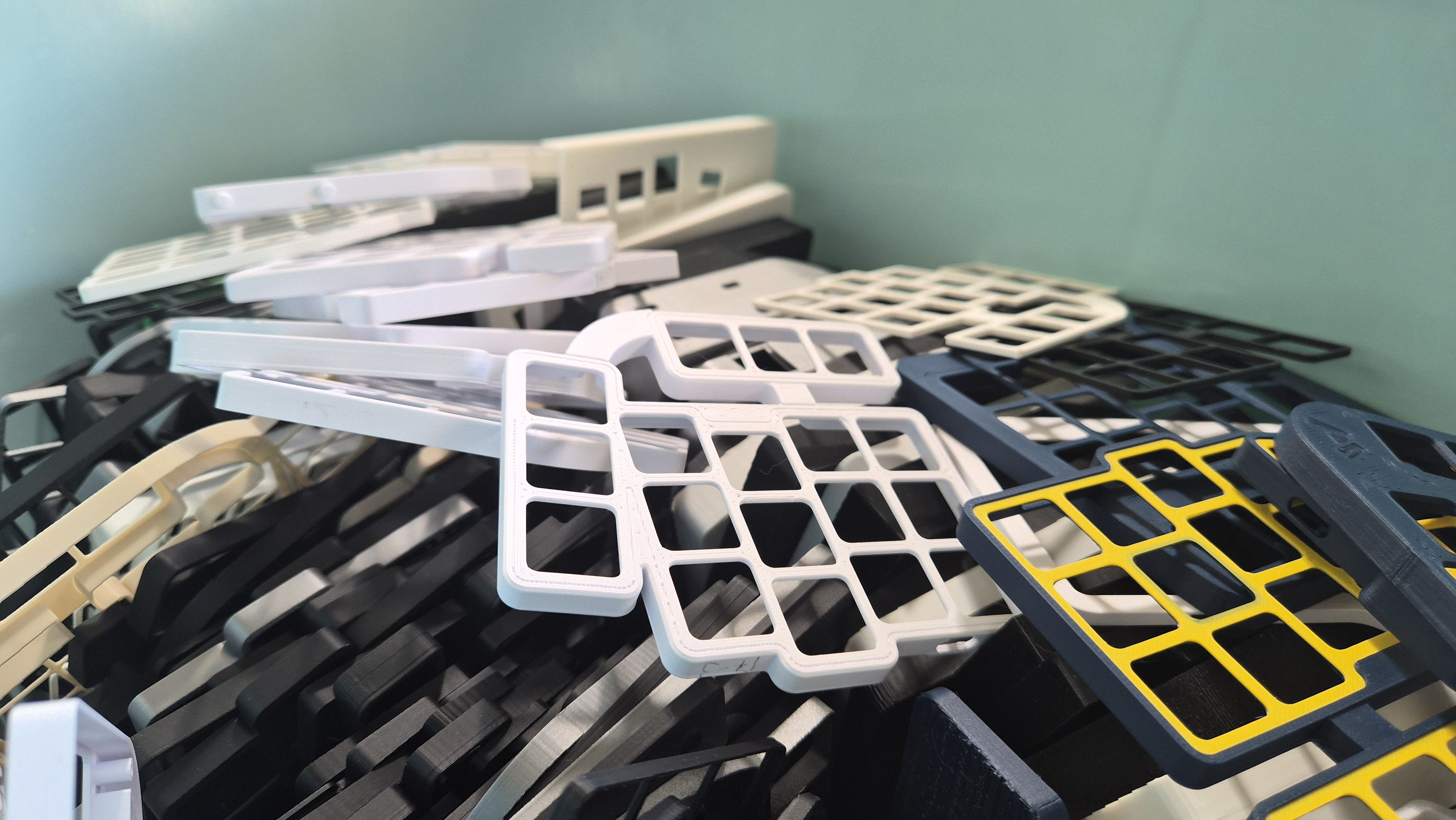
More than fifty 3D-printed prototypes later — each one measured against real hands, tested, and discarded — the Cogito reaches its final form(s). The first keyboard designed not to improve the typewriter, but to replace the idea of it.
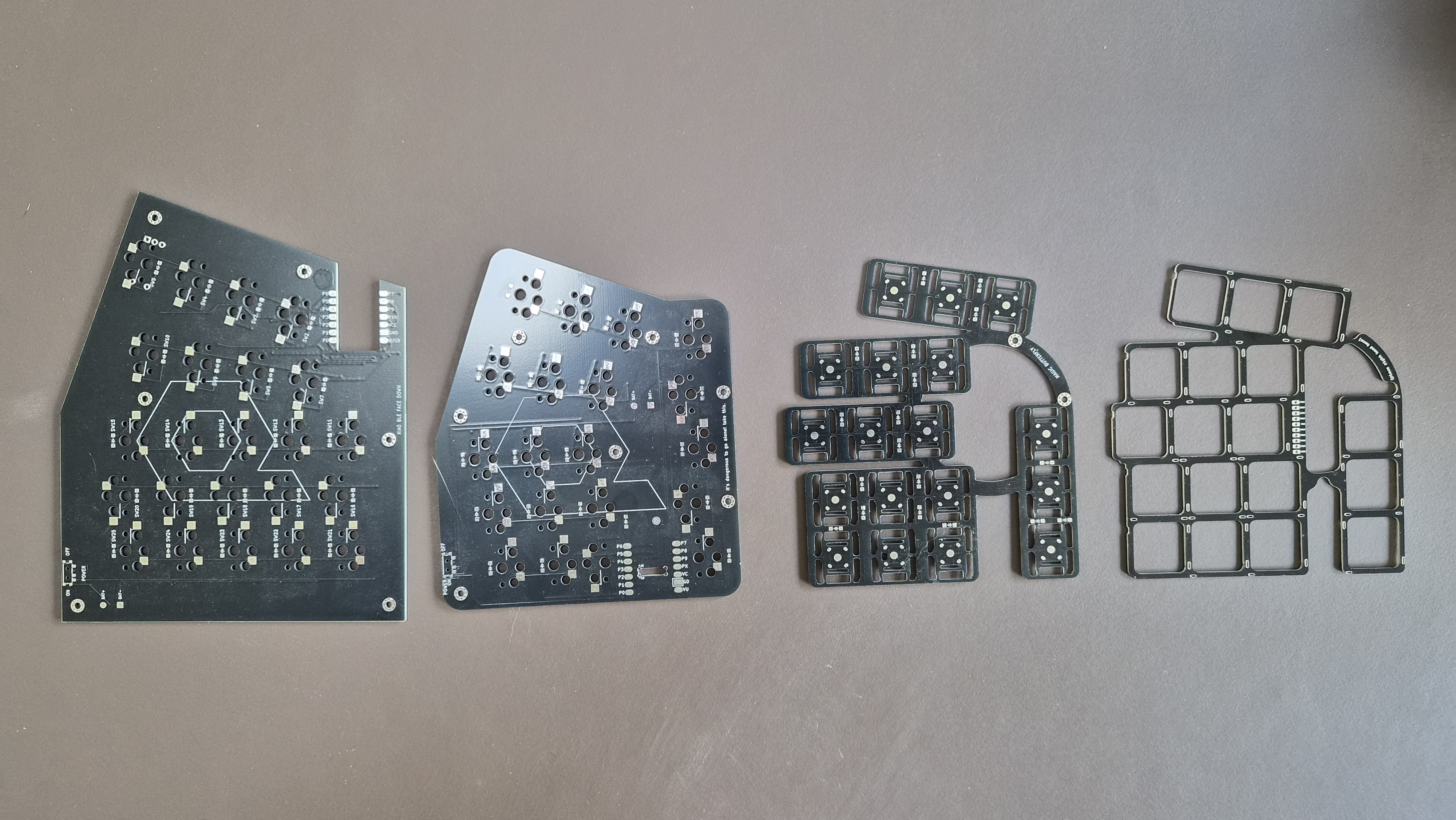
FIG 03. MORE THAN FIFTY ITERATIONS // THE EVOLUTION OF THE COGITO
the Switch
When I started building my own keyboard, I didn't know anything about switches — I just ordered some cheap MX switches. I quickly realised that my idea of a perfect keyboard was mainly about versatility and portability, so I made the switch (…) to Choc, which are roughly half the height.
At the time the main keyboard that I was using was an Apple Magic Keyboard and unlike a lot of mechanical keyboard enthousiasts online, I actually really liked using it and typing on it;
- The integration with Mac OS is perfect
- It’s flat and portable
- There is virtually no difference between typing on that keyboard or on the keyboard from the Macbook itself, meaning that transitioning between the two would be effortless
The major downside of course was that it was not very ergonomic; it’s not ortholinear and it’s not a split keyboard. But what if I could use the switches that Apple used for these keyboards to create my own layout and turn it into a split keyboard? The idea sounded simple, but with the delicate switches and the keyboard being glued together, it was actually quite the challenge to source the components. That’s when I stumbled upon a post by Nemoto on my favourite subreddit r/ErgoMechKeyboards. I was really impressed by the work he had done and I reached out and asked if he would be willing to share the PCB footprints with me, which he was kind enough to do.
From those Kicad footprints I made a PCB and I really thought that if I would get this to work, this was going to be my ‘endgame’ keyboard, but right around that time Framework decided to reveal their One Key Modules and they were exactly what I needed for this project:
- Not necessary to carefully tear down (broken) keyboards to get the right components
- Switches that would actually be reliable in the longterm (unlike Apple’s butterfly switches)
- Super thin profile
So when I saw that they were looking for developers to test these switches, I didn’t
hesitate and immediately sent them a proposal for joining the program.
Out of all the applications they got I was actually selected as one of the first
people in the world to build a keyboard with these switches!
I could have just converted my PCB for the Magic Keyboard switches to the Framework switches, but I actually decided to start over completely; starting with redoing the measurements of my hands and fingers and adjusting the layout of the keys accordingly and doing a lot of research online about how I could make this keyboard truly perfect (for me).
The result of all of that work are the Cogito keyboards — super thin, versatile and modular, but most importantly, actually made for my hands and fingers.
the Name
The keyboard is called the Cogito after Descartes' Cogito, ergo sum — "I think, therefore I am." A keyboard is the most direct physical instrument through which thought becomes reality. Every key pressed is an act of sum — bringing something into being that did not exist before.
But the name carries more than the obvious reference.
What made Descartes remarkable was not the conclusion but the method: systematically doubt everything inherited, trust only what can be verified, and rebuild from first principles. The Cogito keyboard is named not for the phrase but for the process — the same process that produced it.
The middle word does double duty. Ergo means "therefore" in Latin — but it is also the root of ergonomics, from the Greek ergon, meaning work. Buried in the most famous philosophical sentence ever written is the word that defines the keyboard's entire design principle. Cogito, ergo sum — I think, ergonomically, I am.
Three words. Three layers. The entire story of the keyboard compressed into a sentence that was never meant to describe one.
the Design
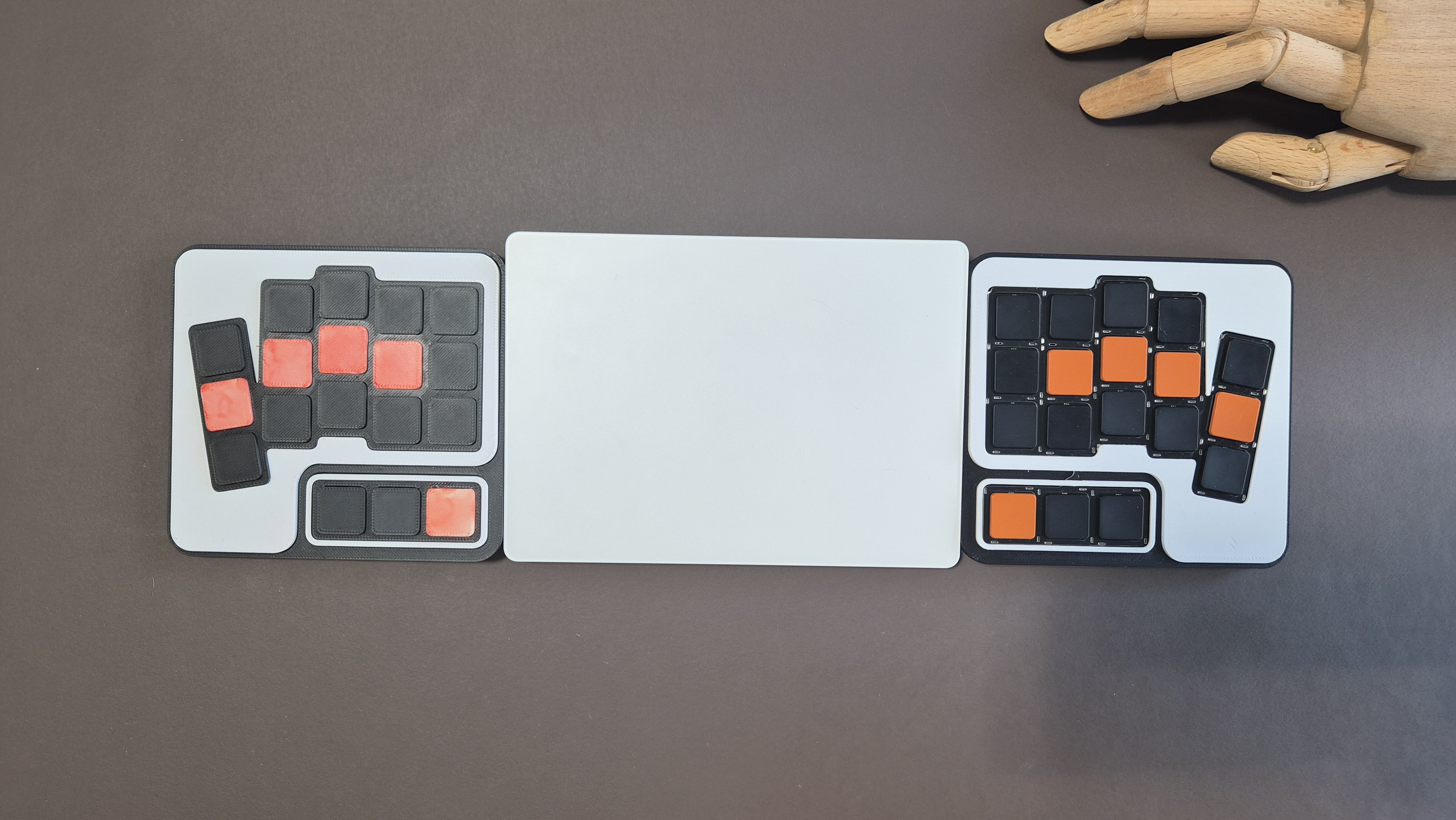
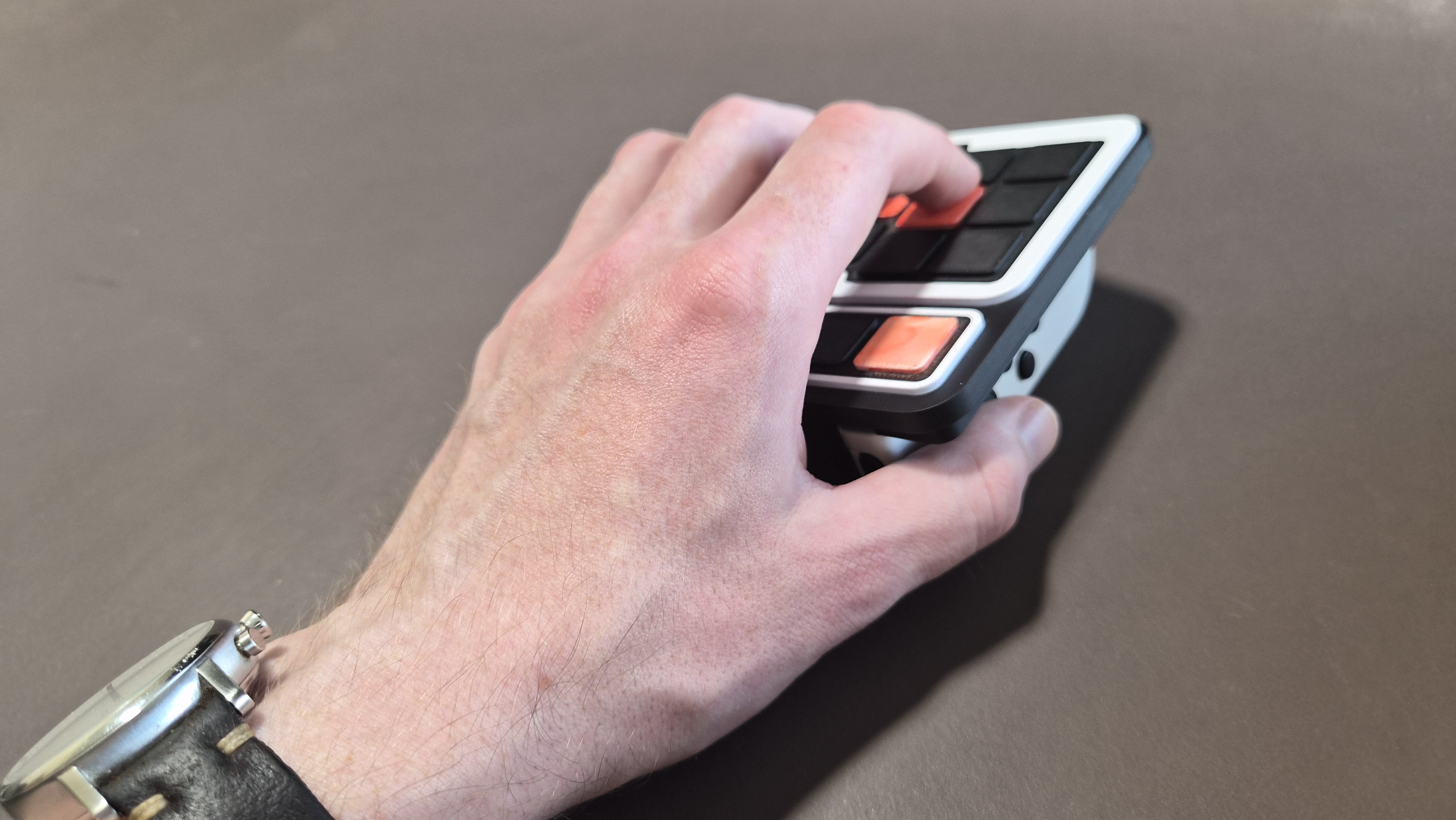
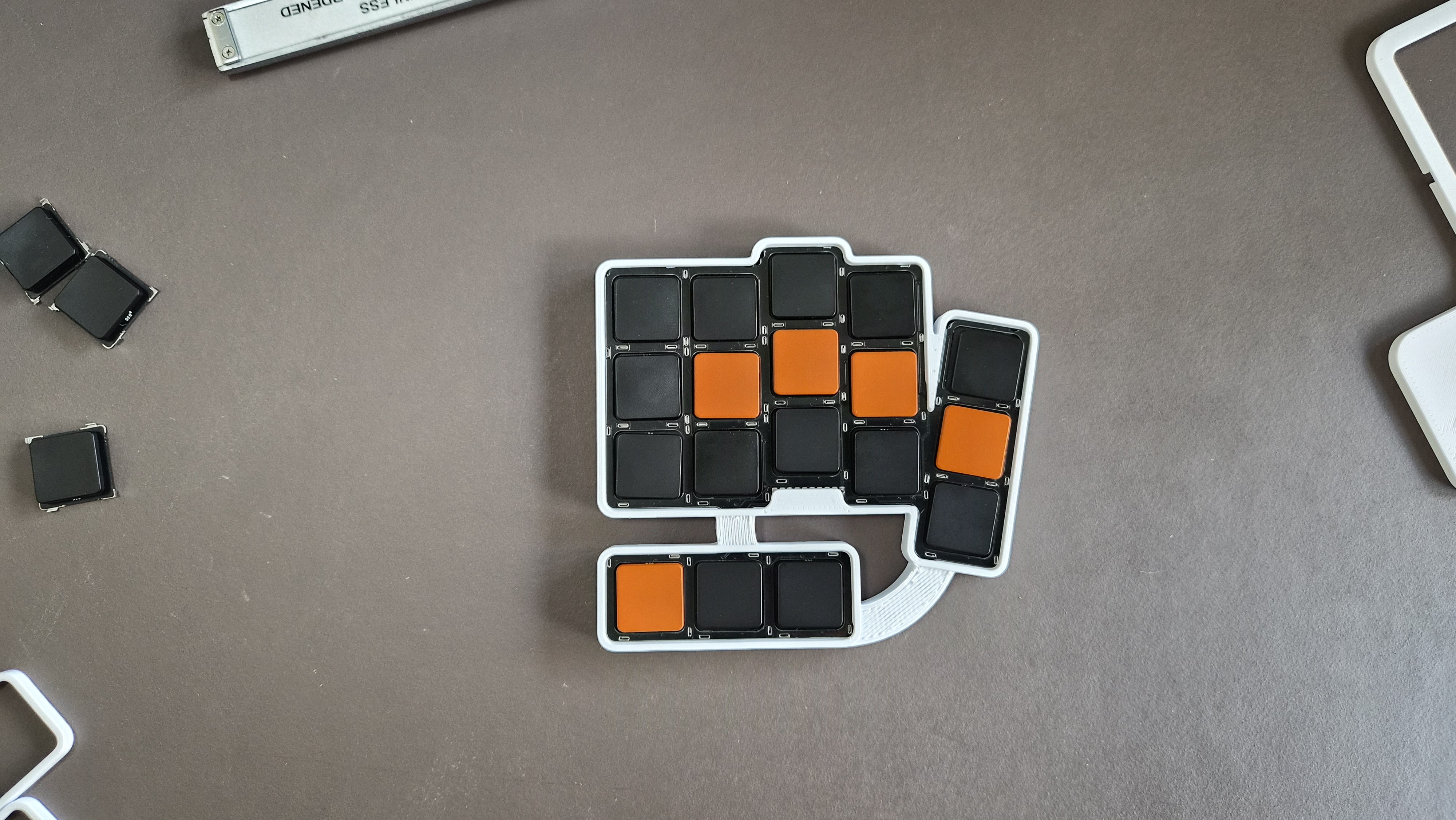
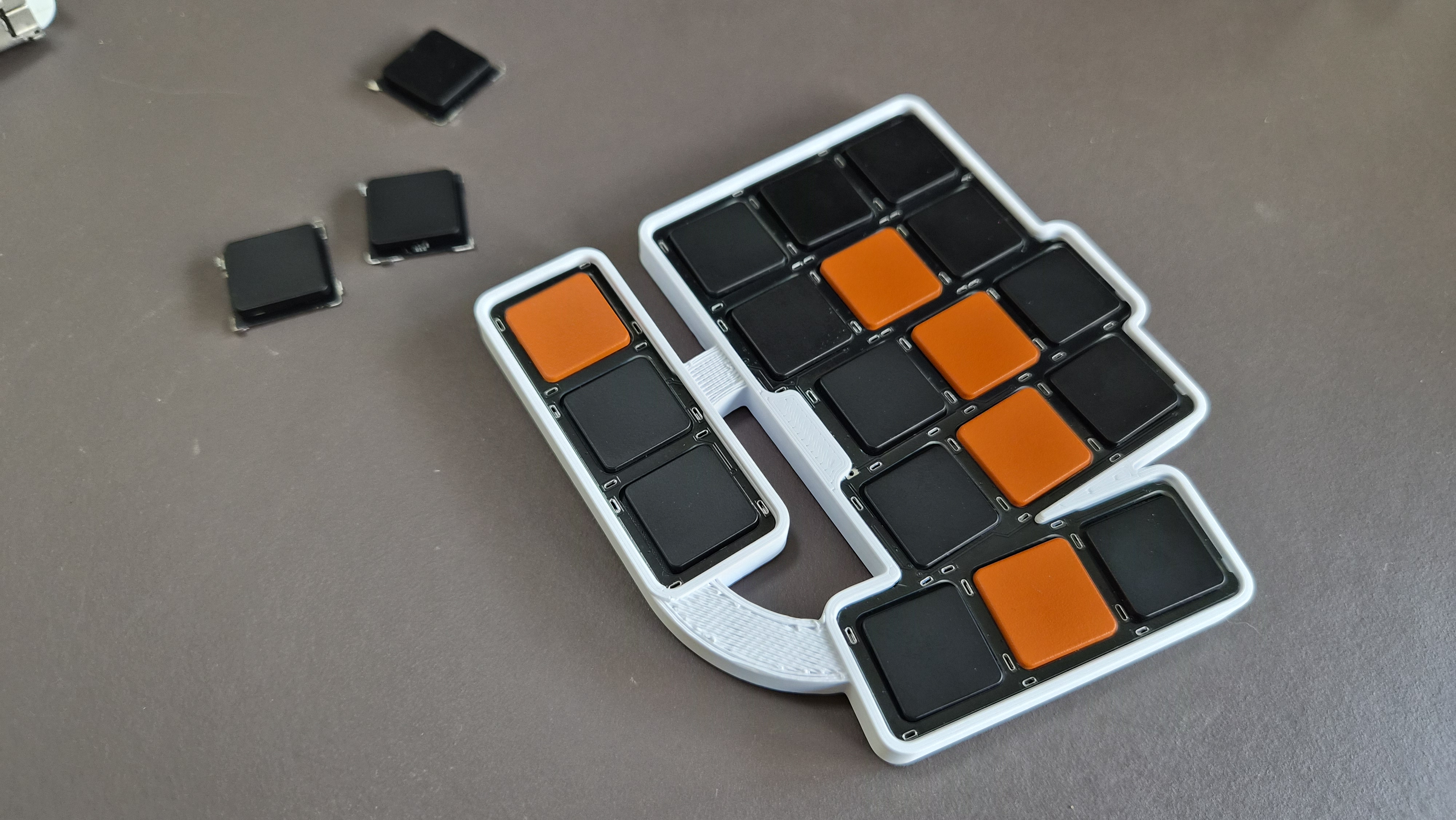
The Cogito is a split keyboard. Each half is an independent unit, designed to sit at shoulder width with a slight inward tent — the natural resting position of two hands, rather than the forced convergence of a flat rectangle.
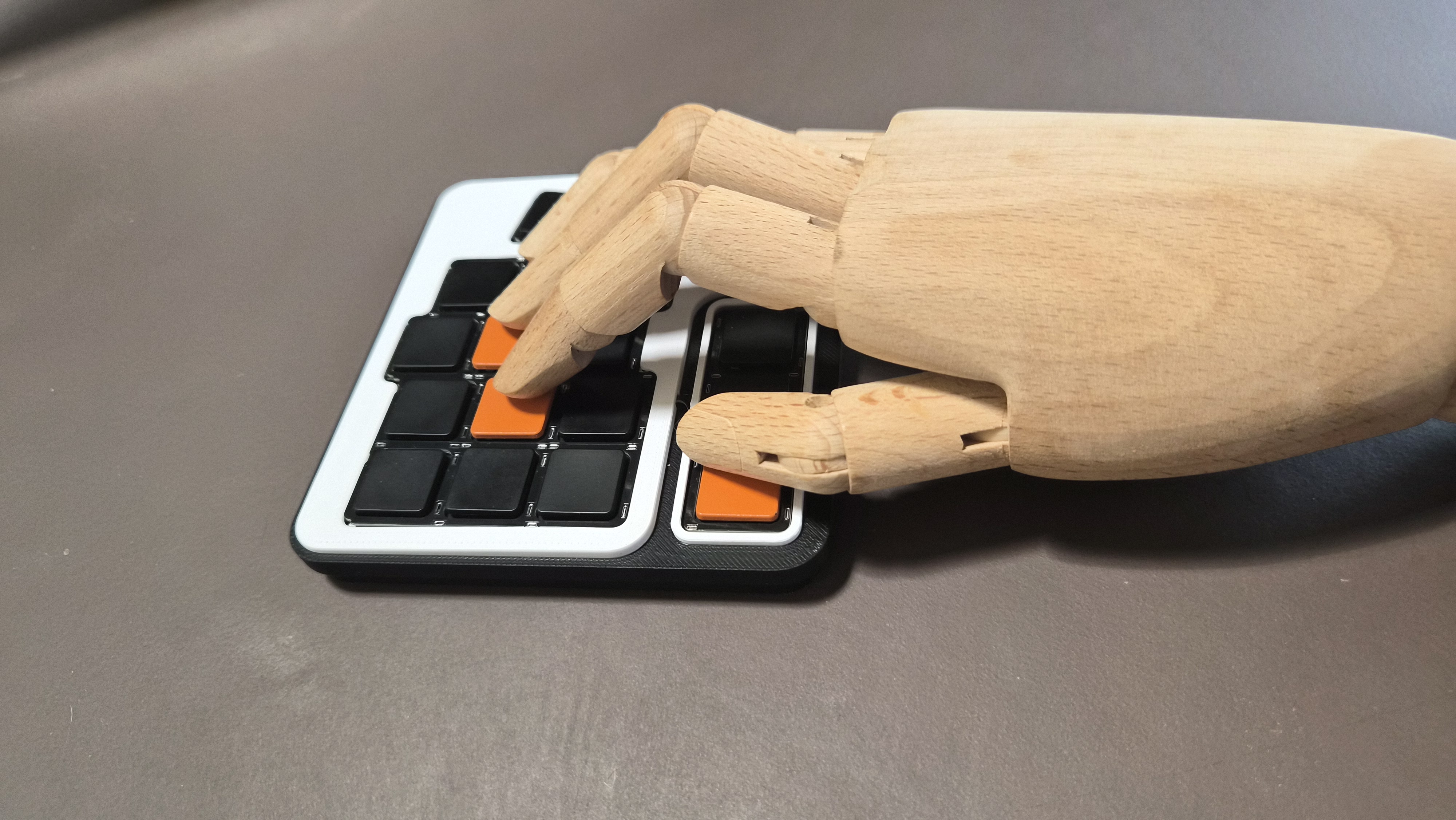
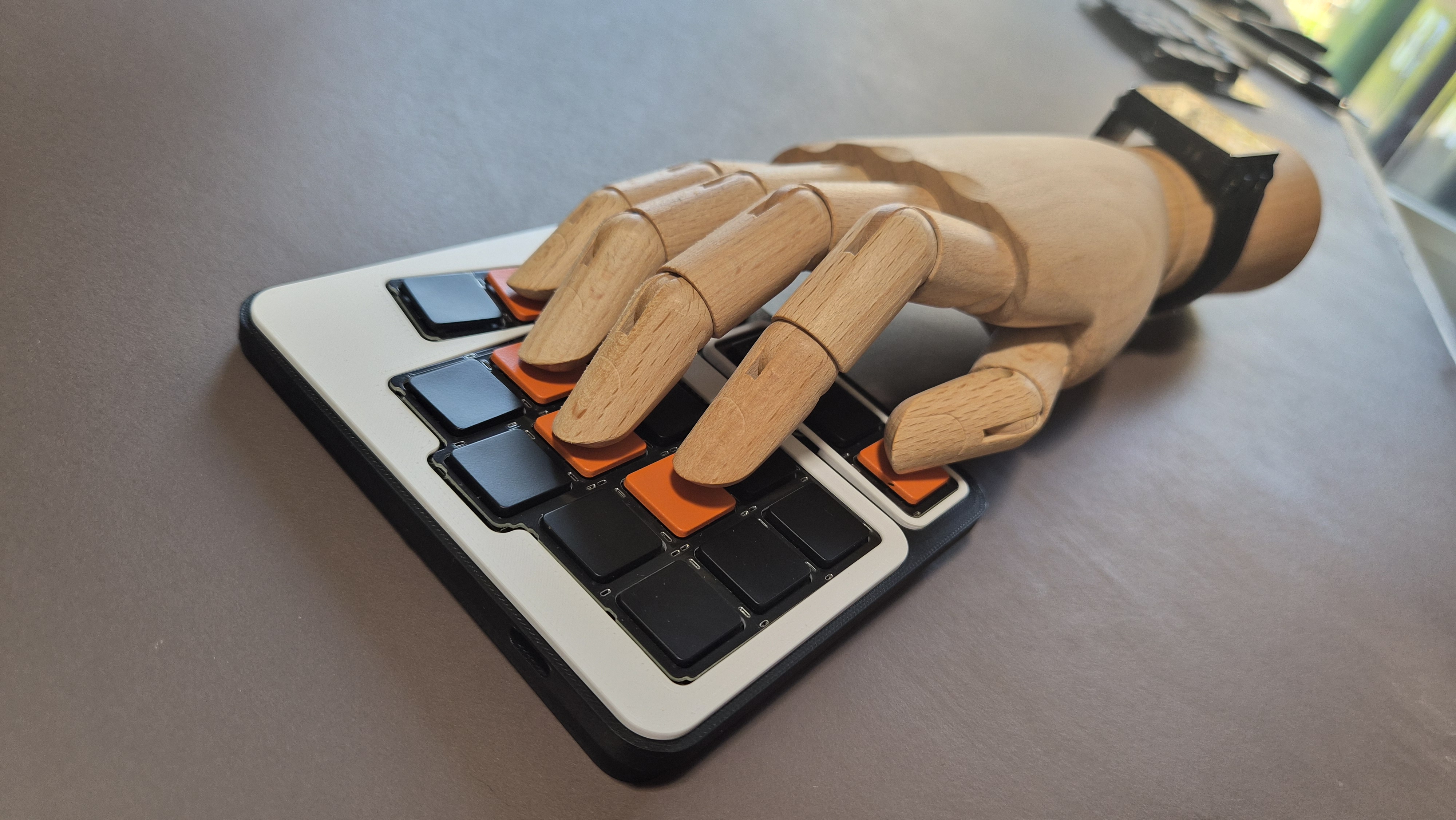
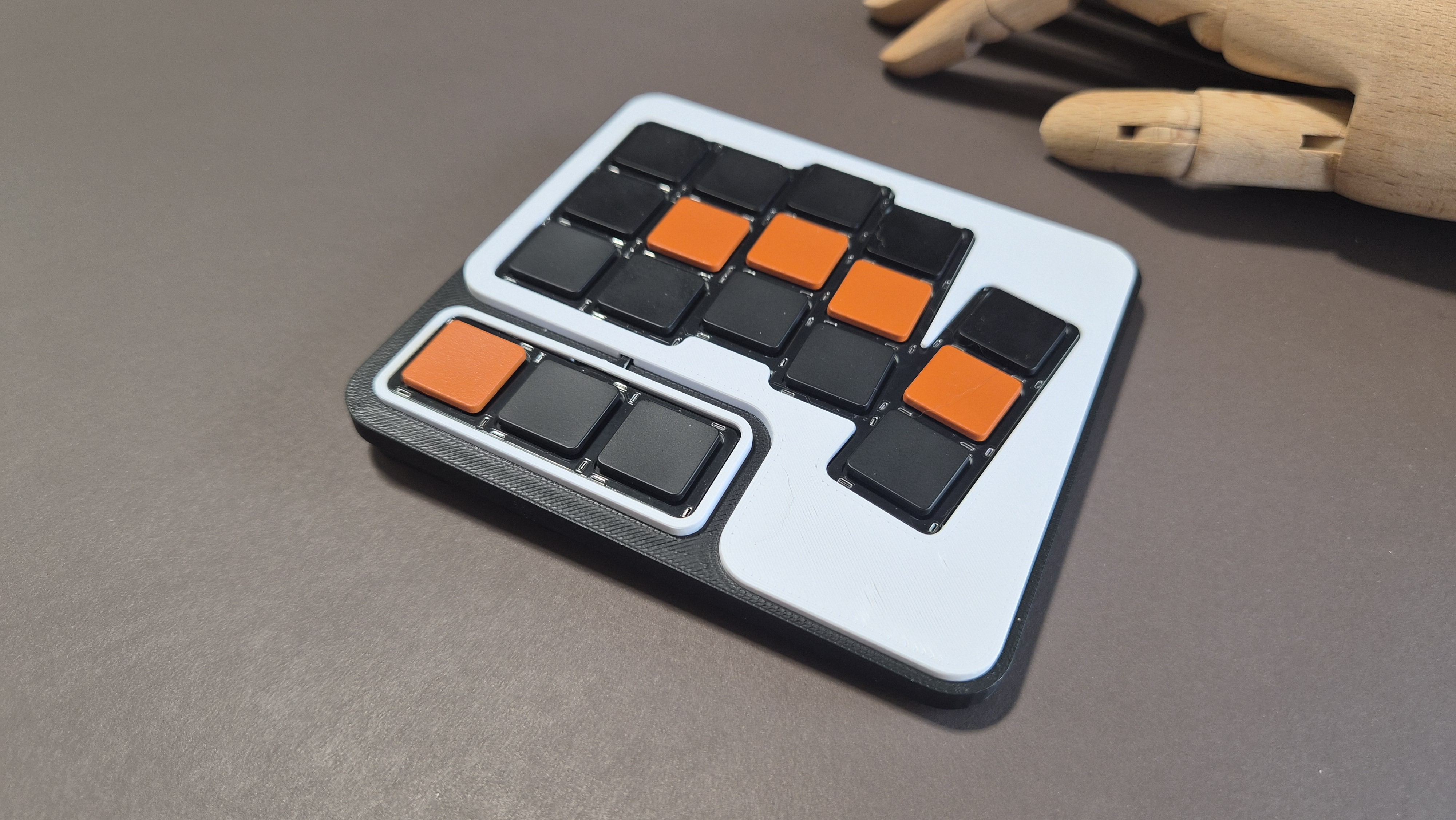
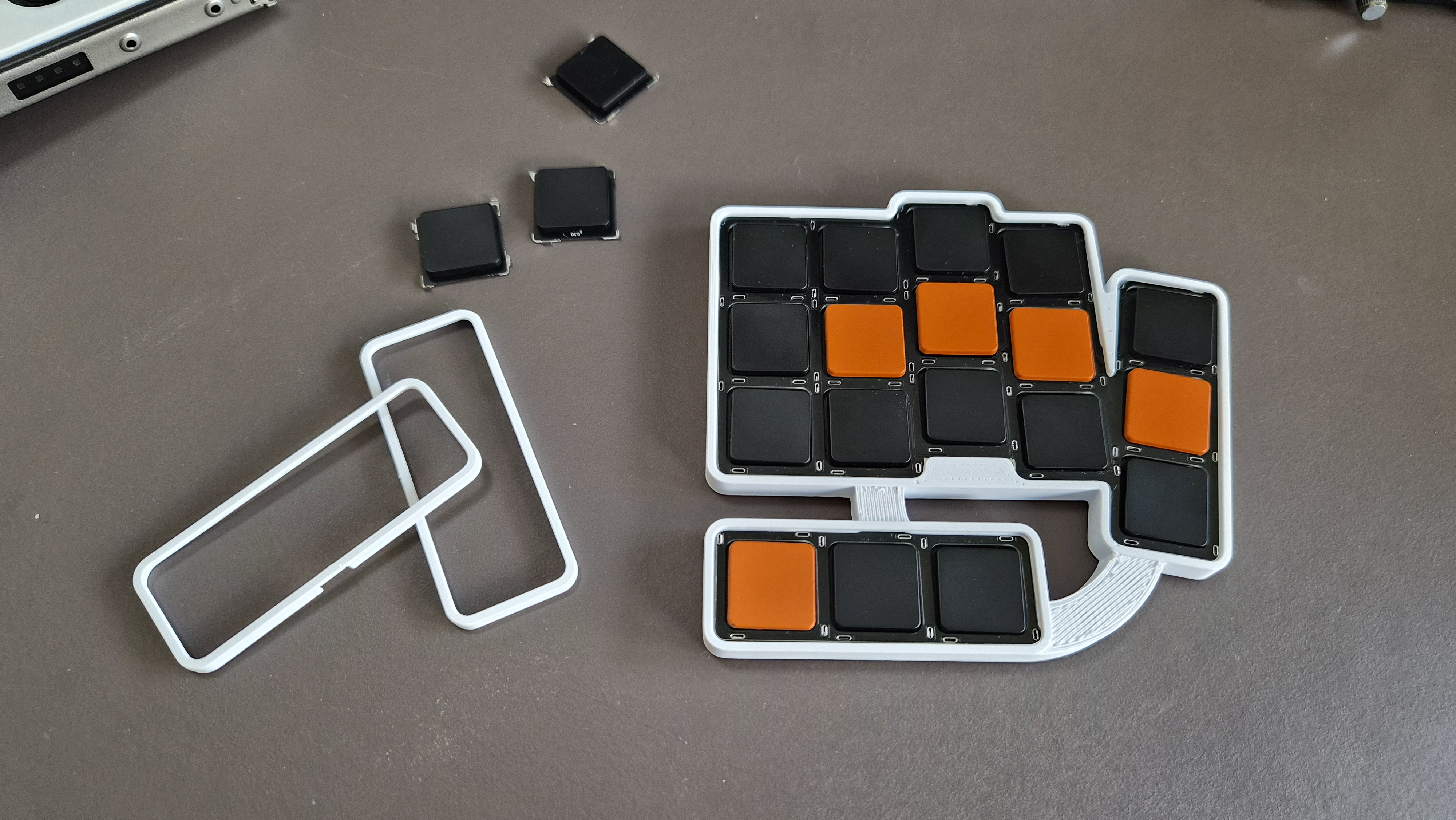
Columnar stagger. The key columns are offset vertically to reflect actual finger length differences. The middle finger column sits highest; the ring and index columns step down from it; the pinky cluster steps down further still. Every finger rests on its home key with zero extension or curl. There is no horizontal stagger — that was always the typewriter's geometry, not the hand's.
The pinky cluster. The pinky column is a physically separate piece, rotated outward at roughly 15° to match the natural divergence of the fifth finger from the other four. This is the detail that most ergonomic keyboards never address — and the one that eliminates the sustained lateral strain that accumulates in every standard layout.
The thumb arc. Each half carries a three-key thumb cluster positioned where the thumb naturally falls — inward, sweeping toward the palm in the direction of natural opposition. Across three keys, the deviation from the thumb's natural arc is less than the contact surface of a single keycap. The horizontal arrangement is not a compromise; it is a geometric approximation precise enough to make a physical curve unnecessary.
Six thumb keys, twelve inputs. Where a standard keyboard dedicates both thumbs to a single 118mm bar that does exactly one thing, the Cogito gives each thumb three keys. Using ZMK firmware's hold-tap behaviours, those six physical keys carry twelve distinct inputs: Space, Enter, Backspace, Delete, Shift, and full layer access — all within the natural inward sweep of both thumbs, without either one ever reaching outward.
36 keys total. Everything else lives in layers — accessed by holding a thumb key, exactly as a musician shifts register rather than growing extra hands. The keyboard is compact because the hand is compact. The keys that remain are the ones the hands can reach without moving.
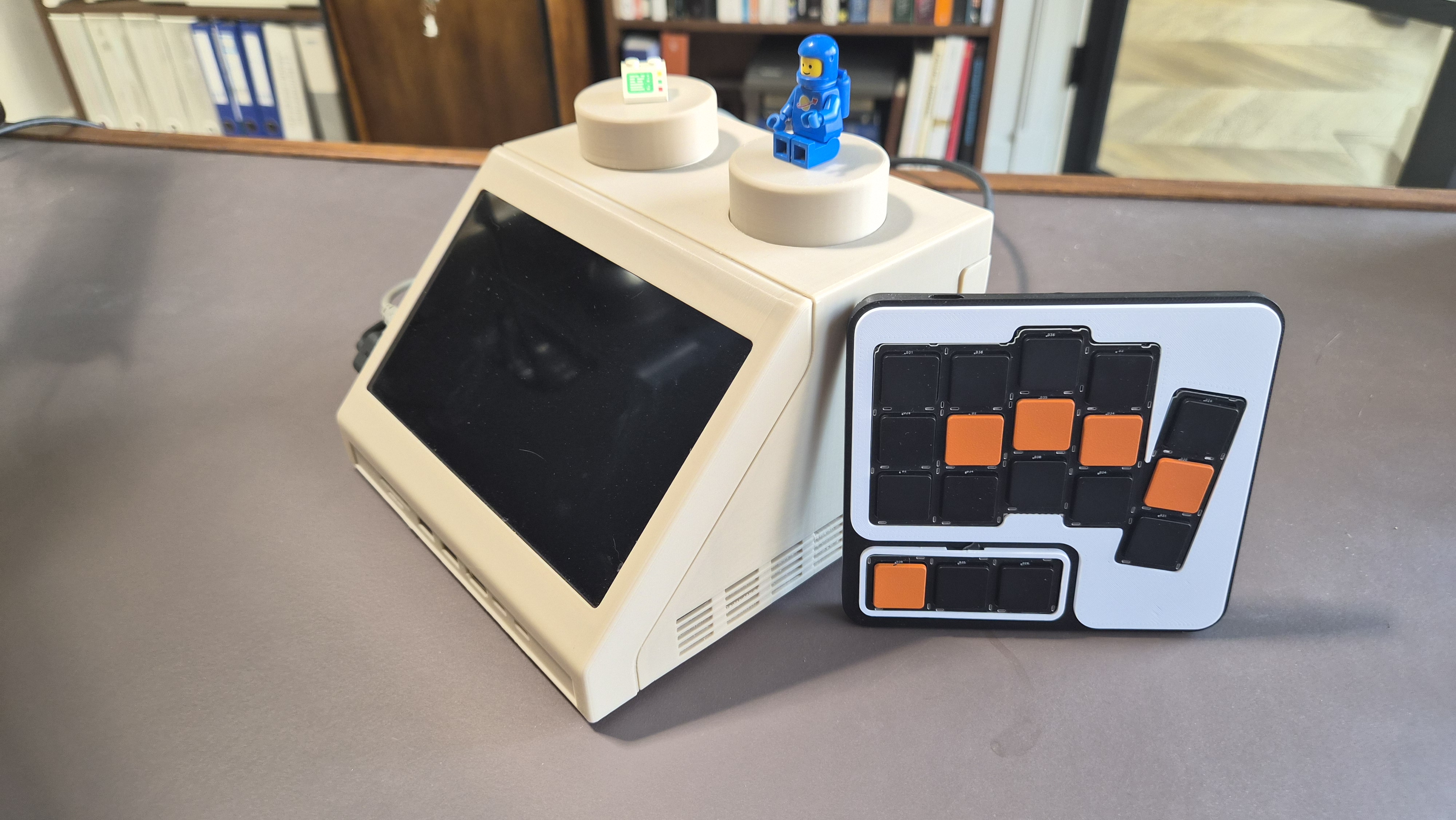
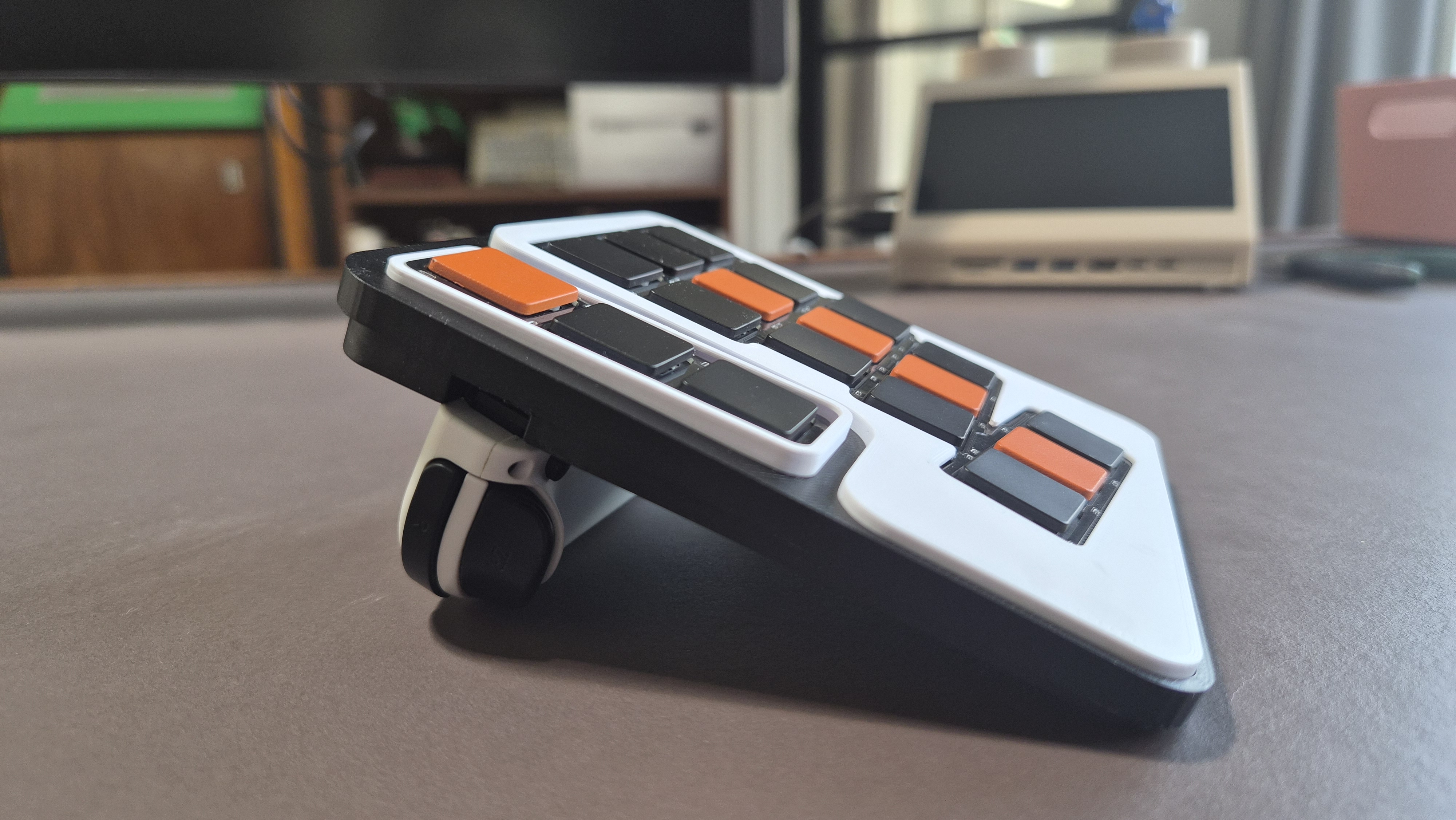
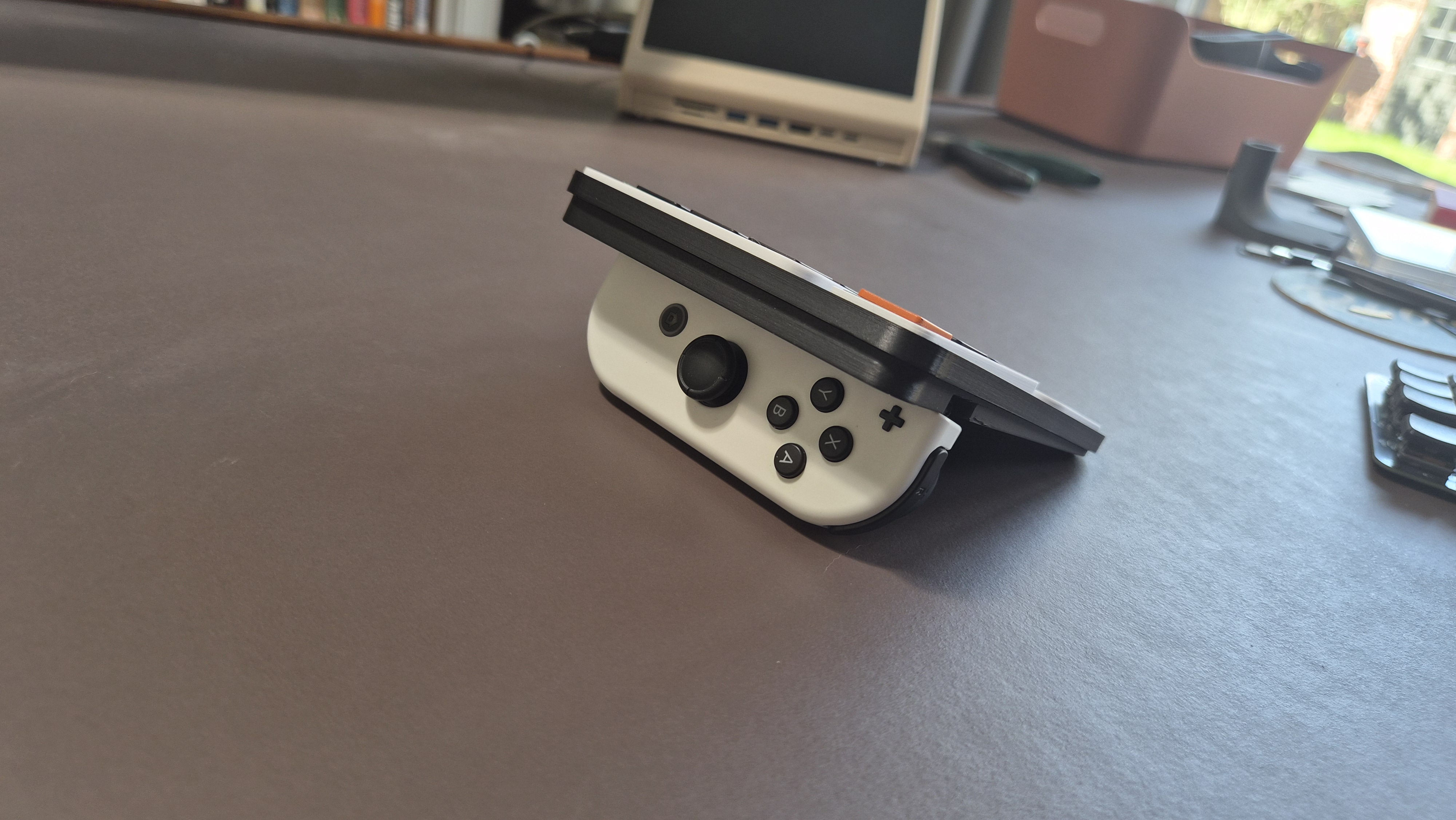
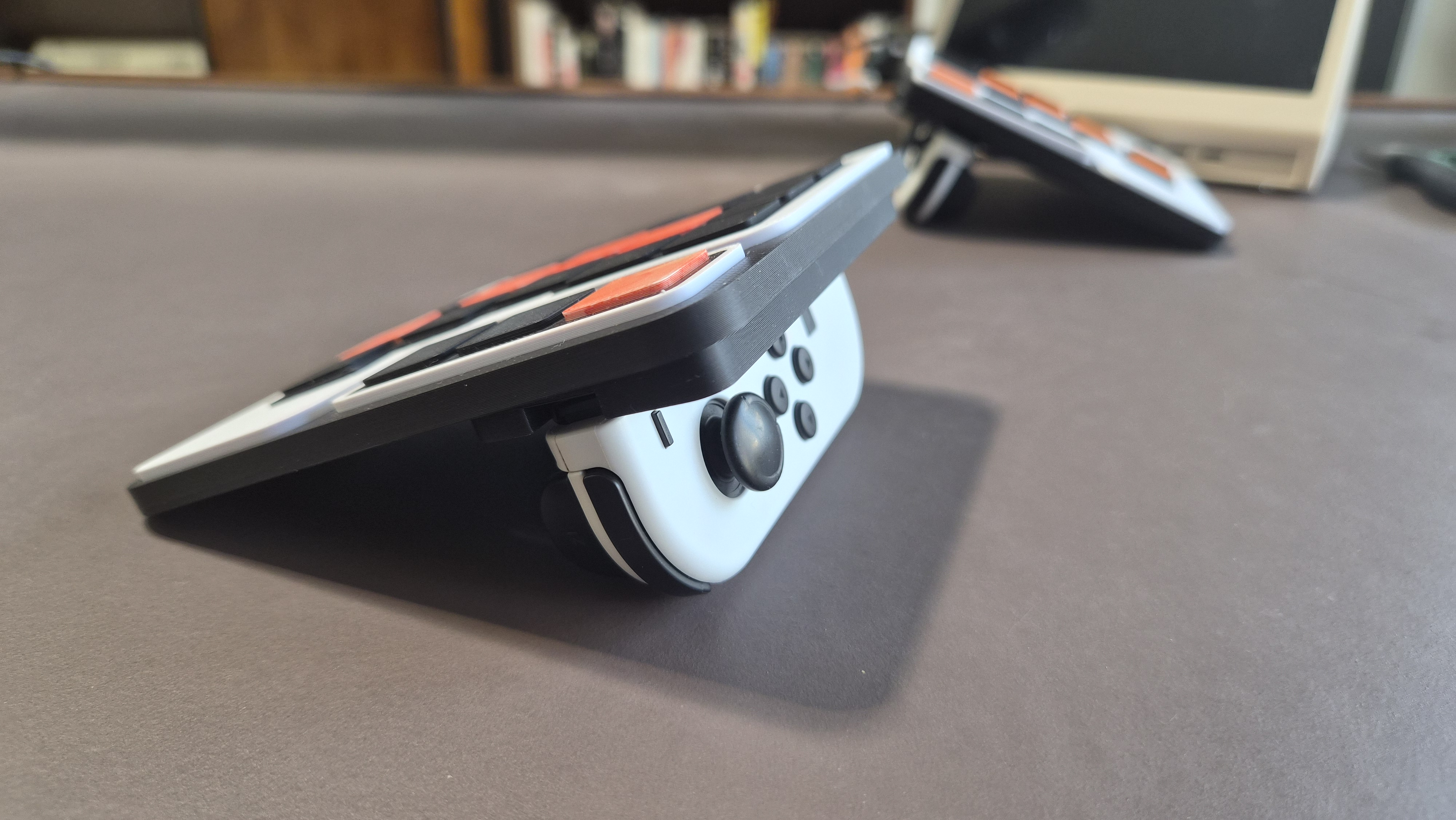
Flat for portability, tented for ergonomics. Each half carries a MagSafe-compatible mount point — the same connector used for tenting stands, for storage on the back of the iPad mini, and for attaching to the rail of the system it was designed to complete. One physical detail that serves three purposes.
Features
| Cogito+ | Cogito | |
|---|---|---|
| Keys | 36 | 36 |
| Columnar stagger | ✓ | ✓ |
| Rotated pinky column | ✓ | ✓ |
| Thumb arc (3 keys per hand) | ✓ | ✓ |
| Wireless | ✓ | ✓ |
| Magnetic carrying mode | ✓ | ✓ |
| MagSafe mount point | ✓ | ✓ |
| Integrated tenting | 3° | — |
| Joycon tenting capability | ✓ | — |
| Battery life | Longer | Long |
×
the Fossil
If an alien archaeologist dug up a standard keyboard a million years from now, they would reconstruct the human hand as a flat, rigid plate with ten identical, equally-spaced digit-tips — and a blunt, passive ridge where the thumb should be.
Every feature of the keyboard we use today is a fossil of 1870s mechanical engineering, faithfully inherited but never questioned. The Cogito exists because we finally did question it — starting from the hand itself, not the grid. The name says it all: Cogito, ergo sum. I think, ergonomically, I am.
the Breakthrough
By only optimising the candle, you would never invent the lightbulb. Every generation of keyboard designers since 1873 has made the rectangle thinner, quieter, and more wireless — and none of them asked whether the rectangle was the right shape to begin with.
The Cogito is not a better keyboard. It is the answer to a different question.
Digito, ergo sum. I type, therefore I am — with every finger where it belongs, every key where the hand expects it, and the lightbulb finally lit.
Status: In development
The design of the Cogito keyboards is finalized, but the 3D-models and files still need some work before they are released.
Support our work
You can support our work by making a donation or by purchasing one of our products from our store. Your contribution directly funds the materials and coffee needed for the next prototype.